Table of Contents
Most people who say they “can’t sing” have never actually tried to learn how to sing. They just sang badly once, got embarrassed, and decided their voice was broken. It’s not. Singing is a physical skill — like swimming or typing — and like any skill, it responds to practice. You’re not born a great singer any more than you’re born a great swimmer. You just need to know where to start.
This guide covers exactly that: the fundamentals of how to sing better, straight from what vocal coaches actually teach, minus the fluff.
Why Anyone Can Learn to Sing (Yes, Even You)
Here’s what most people get wrong about the singing voice: they treat it like a gift you either have or don’t. That’s not how it works.
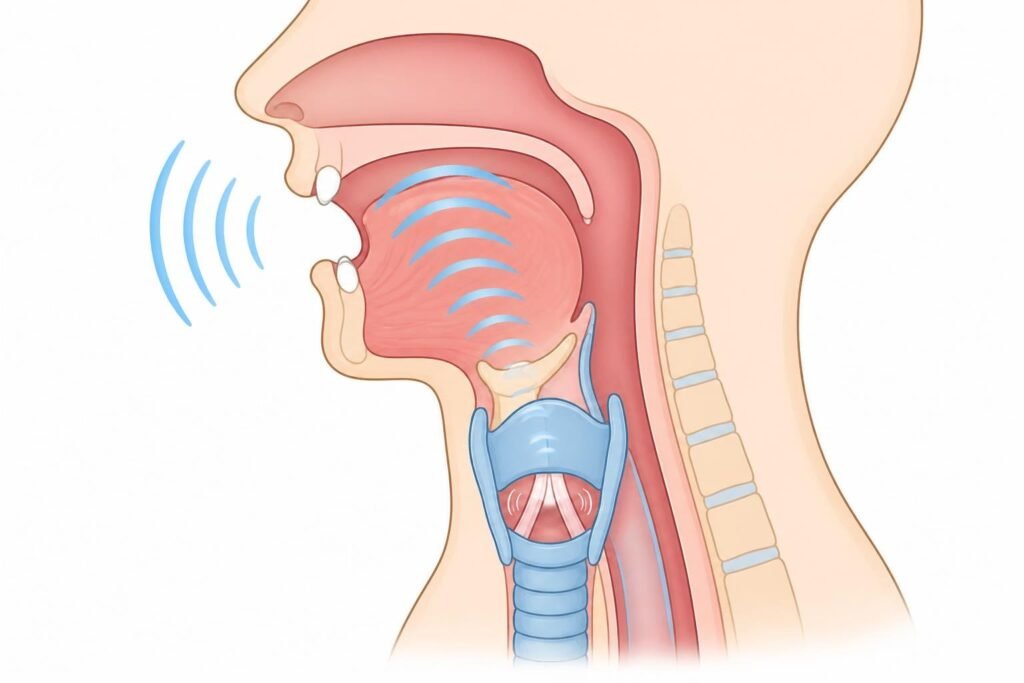
Your voice runs on vocal folds — two small bands of muscle inside your larynx (voice box) that vibrate to create sound. Those muscles can be trained. A singer who sounds polished after two years of lessons has spent hundreds of hours conditioning those folds, just like a runner conditions their legs.
Research backs this up. Studies on amateur singers consistently show measurable pitch improvement after just eight weeks of structured practice. You don’t need perfect genetics — you need a method.
The one caveat: some people start with more natural ability to sing in tune or carry a melody. But “natural talent” determines your starting point, not your ceiling. Anyone can learn, and most beginners are much closer to decent singing than they think.
The First Thing to Fix: Breathing and Posture
Before you worry about pitch, tone, or hitting a high note — sort out your breathing. Almost every bad habit a beginner singer has traces back to poor breath support.
Stand Up Straight (It Actually Matters)
Good posture isn’t a polite suggestion. When you slouch, your lungs compress and you get maybe 60–70% of your potential air capacity. Less air means your vocal cords have to work harder to produce sound, which leads to strain and an unstable tone.
Stand with feet shoulder-width apart, shoulders relaxed and slightly back, chin parallel to the floor. Don’t lock your knees. Think “tall but easy” — not military stiff, just open.
Sing from the Diaphragm
You’ve heard this before. But what does it actually mean?
The diaphragm is a dome-shaped muscle beneath your lungs. When you breathe properly for singing, it drops down and your belly expands — not your chest. This is diaphragmatic breathing, and it gives you the steady airflow that makes a note sound controlled instead of shaky.
Try this: put one hand on your chest and one on your belly. Take a deep breath. If your chest moves first, you’re chest-breathing. Retrain yourself to feel the belly expand. That’s your foundation.
Always Warm Up Before Singing — Every Single Time
You wouldn’t sprint without stretching. Your vocal cords are muscle tissue, and cold muscles under stress get injured. Skipping your warm-up is one of the fastest ways to strain your vocal cords and set back weeks of progress.
A solid vocal warm-up takes 10–15 minutes and should move from gentle to more demanding.
A Simple Warm-Up Routine
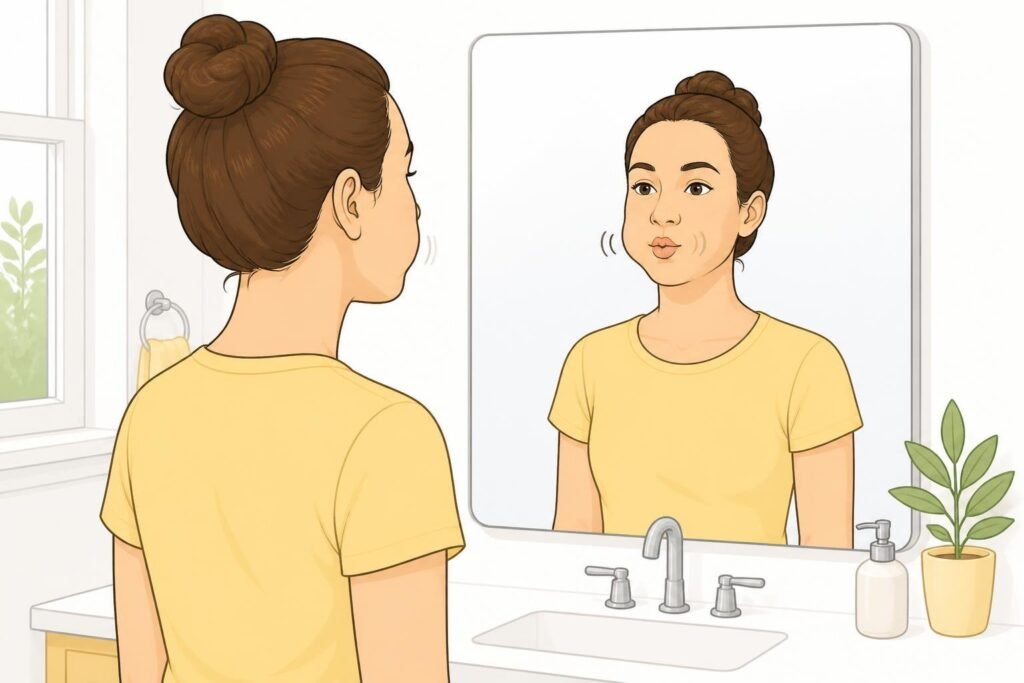
- Lip trills: Blow air through closed lips so they flutter. This releases tension and warms up the breath-to-voice connection.
- Hum on a five-note scale: Start in the middle of your range, go up and back down. Keep it light and easy.
- Sirens: Slide from your lowest comfortable note to your highest on an “ng” sound (like “sing”), then back down. This stretches your full vocal range without forcing anything.
- Vocal exercise on vowels: Sing “ah-eh-ee-oh-oo” up a half step at a time. This opens up resonance and gets your mouth and jaw moving.
Don’t push for your highest notes in the warm-up. You’re waking up the instrument, not performing on it.
How to Improve Your Pitch (Without Losing Your Mind)
Pitch is the most fixable problem beginners face. If you sing out of tune — too sharp, too flat, or just wobbly — it’s almost never a permanent condition. It’s usually one of three things: you’re not listening closely enough, your breath support is off, or you haven’t trained your ear yet.
Train Your Ear First
Singing in tune starts with hearing accurately. If you can’t hear the difference between two notes, you can’t match them. Ear training doesn’t have to be fancy — sing scales along with a piano app or a YouTube channel dedicated to vocal training. Sing intervals (two notes at a time), check yourself, adjust.
One of the most useful things you can do: record yourself singing. Your voice sounds different in your head (bone conduction distorts it) than it does to a listener. Recording reveals pitch problems you’d never catch in the moment.
The Pitch-Breath Connection
Flat pitch — singing below the note — is almost always a breath support issue. You’re running out of air before the note ends, so the pitch sags. Fix your diaphragmatic breathing, and flat notes often fix themselves.
Sharp pitch — singing above the note — usually comes from tension. You’re gripping. Relax your jaw, drop your shoulders, and let the note out instead of pushing it.
How to Sing High Notes Without Straining
This is where a lot of singers hit a wall. The high note they want sounds tight, squeaky, or just disappears. Here’s what’s going on.
Chest Voice, Head Voice, and Mix Voice
Your voice naturally operates in different registers:
- Chest voice is your speaking range — rich, full, and grounded.
- Head voice is your upper range — lighter, brighter, and resonating more in your head.
- Mix voice is what professional singers spend years developing: a blend of both registers that lets you sing high notes with power and without strain.
Most beginners either push their chest voice too high (strain) or flip into a weak falsetto (no power). The goal is learning to blend — to carry chest resonance up as you ascend in pitch.
You won’t nail this overnight. But awareness is the first step. When you feel strain climbing toward a high note, that’s your body telling you it’s time to shift registers, not push harder.
Tips to Help You Sing Higher
- Raise your soft palate (the back of your mouth) as if you’re about to yawn. This opens up space for higher notes.
- Keep your larynx neutral. Lifting your chin as you go high raises the larynx and squeezes the sound — it won’t help you hit the note, it’ll strangle it.
- Think the note up and over, not up and out. Some singers find it helps to imagine the note arcing like a thrown ball rather than shooting straight ahead.

Singing With Emotion: The Part Most Tutorials Skip
Technical skill gets you in tune. Emotion gets people to care.
Great singers don’t just hit the right notes — they make you feel something. And here’s the thing: you can teach yourself to sing with more expression, not just more accuracy.
Start with the words. Before you sing a song, read the lyrics out loud like a spoken monologue. Find the emotional peak of each phrase. Where’s the tension? The release? What is this lyric actually saying?
When you try to sing it back, you’ll automatically lean into certain words, push a phrase slightly, or let another one fall soft. That’s interpretation — and it’s more compelling than any technically perfect but emotionally flat vocal performance.
Vocal technique matters, but it’s in service of the song. Don’t let drills and scales make you forget that a singer’s job is to connect.
Should You Get a Vocal Coach?
Honest answer: yes, if you can.
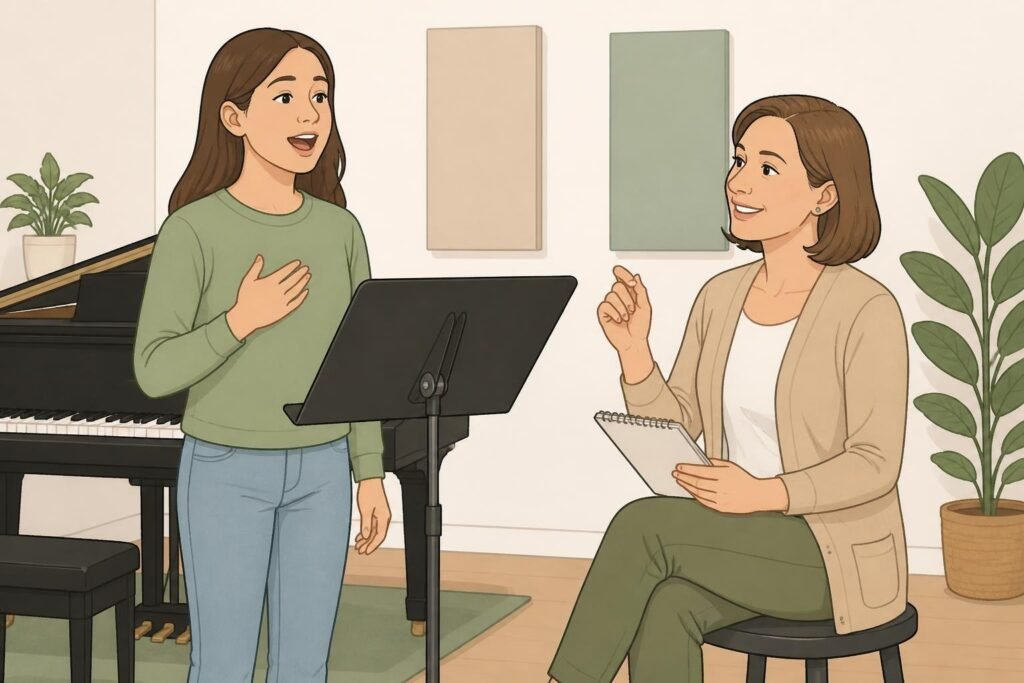
A good vocal coach watches your posture, listens for tension in your tone, catches pitch problems you don’t hear, and gives you targeted feedback that no article or app can replicate. Even a few sessions can shift your trajectory dramatically — you avoid building bad habits that are harder to fix later.
If in-person singing lessons aren’t accessible or affordable, there are solid alternatives. Online singing lessons through platforms like Lessonface or 30 Day Singer give you structured singing courses with real feedback. Some platforms now offer an AI vocal coach — tools that listen to your voice and flag pitch accuracy, tone, and timing in real time. It’s not a replacement for a human voice teacher, but for daily singing practice between lessons, it’s legitimately useful.
Whatever route you take, don’t just learn how to sing better passively. Sing along, get feedback, and adjust.
Vocal Health: How to Protect Your Voice
Your voice is fragile in ways most beginners underestimate. One bad week of habits — too much yelling, not enough water, singing through illness — can set you back noticeably.
Daily Habits That Affect Your Singing Voice
- Hydrate. Your vocal folds need moisture to vibrate efficiently. Aim for 8+ glasses of water daily, and cut back on caffeine and alcohol, which dry out the throat.
- Don’t whisper. Whispering actually puts more strain on your vocal cords than speaking softly. If your voice is tired, use a gentle low volume instead.
- Go on vocal rest when you’re sick or hoarse. Singing on a strained voice makes the injury worse and longer-lasting.
- Avoid clearing your throat. It’s a habit, and it’s rough on your vocal folds. Swallow instead, or sip water.
Vocal health isn’t glamorous, but it determines whether the practice you put in actually sticks.
How to Structure Your Singing Practice
You don’t need three-hour sessions. You need consistent, focused ones.
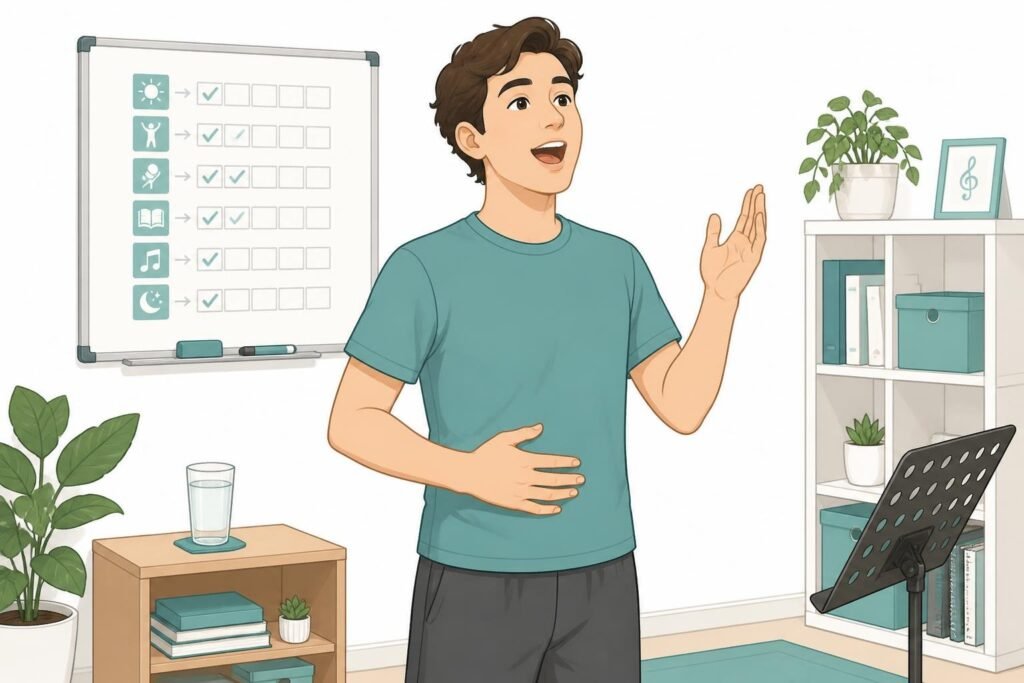
A 30-minute practice session that happens every day beats a two-hour Saturday binge every time. Here’s a simple structure:
- 5–10 min warm-up — lip trills, scales, sirens
- 10 min technical work — focus on one thing: pitch accuracy, a specific vocal exercise, or hitting that high note in a passage
- 10 min repertoire — practice singing an actual song, applying what you worked on
- 2–3 min cool-down — easy hums descending in pitch, gentle breath work
Track your progress. Record yourself singing every two weeks. You’ll be surprised how quickly things change when you’re paying attention.
Start Singing — The Only Move That Actually Works
Every singer you admire started exactly where you are: unsure, a little embarrassed, and wondering if they had what it takes. The difference is they kept going.
You now have the framework — posture, breathing, warm-ups, pitch training, register awareness, vocal health, and a practice structure. That’s more than most people ever get from years of random YouTube searches.
Pick one thing from this guide and work on it this week. Just one. Fix your breath support. Do the warm-up before you sing along to your playlist. Record one voice memo and actually listen back.
Good singing doesn’t come from a single revelation. It builds, brick by brick, every time you show up and try.