Table of Contents
You decided to learn a new language. Maybe it was a trip to Lisbon that made Portuguese sound irresistible. Maybe you’ve been watching a Spanish drama without subtitles and understanding nothing. Maybe you just want to prove to yourself you can do it.
Here’s the honest truth: most people quit within the first month — not because language learning is too hard, but because they started the wrong way. They downloaded Duolingo, got bored after two weeks, and called themselves “bad at languages.”
You’re not bad at languages. You just need a better approach. This guide breaks down exactly how to learn a foreign language in a way that sticks — from day one to your first real conversation.
Why Most Language Learning Tips Fail You
The problem isn’t motivation. It’s method.
A lot of advice out there tells you to “immerse yourself” or “just speak” without telling you what to actually do on Tuesday at 7pm when you have 30 free minutes. Vague advice produces vague results.
Good language acquisition happens through consistent, targeted input and output — meaning you need to hear and read the language and use it yourself. Apps alone won’t get you there. Neither will grammar drills that never touch real speech.
The good news: you don’t need to move abroad or quit your job. You need a system.
Set a Clear Goal Before You Learn a Single Word
Before you learn languages the right way, you need to know why you’re learning and what success looks like.
“I want to be fluent” is not a goal. It’s a wish.
Here are goals that actually work:
- Conversational in 6 months: You can hold basic conversations on everyday topics
- Travel-ready in 3 months: You can order food, ask for directions, and handle basic interactions
- Business proficient in 12 months: You can write emails and discuss work topics in your target language
Write your goal down. Set a deadline. Your learning goals shape every decision after this — which resources to use, how much time to commit, and whether you need a tutor or can go solo.
Choose Your Target Language Strategically
If you haven’t picked a language yet, a few things are worth knowing.
Some languages are objectively easier to learn depending on your native language. For English speakers, Spanish and Portuguese are among the fastest paths to fluency — Spanish typically takes around 600-750 hours, according to the Foreign Service Institute. Arabic, on the other hand, sits at 2,200+ hours and requires learning a new alphabet entirely.
That doesn’t mean you should avoid Arabic if that’s what you want. Learning Arabic is absolutely achievable. Just go in with realistic timing expectations.
What Makes a Language Easier or Harder
- Script: Does the language use a new alphabet? Japanese, Arabic, and Russian all require extra early investment
- Grammar structure: Some foreign language grammars are closer to English than others
- Cognates: Spanish and Portuguese share thousands of words with English — instant free vocabulary
- Resources: The more popular the language, the more learning resources exist
Pick the language that genuinely excites you. Motivation outlasts strategy every time.
Build Your Foundation: Vocabulary and Grammar (Without the Boring Part)

Vocabulary First
You don’t need to memorize 10,000 words to have a real conversation. Research consistently shows that the most common 1,000 words in any language cover around 80% of everyday speech.
Start there.
Flashcards — digital ones especially, using spaced repetition — are one of the most efficient ways to build vocabulary fast. Apps like Anki let you focus on new word review right when you’re about to forget it, which means less time studying and better retention.
Don’t just memorize a list of new vocabulary words in isolation. Learn words in context: in sentences, in phrases, in the kind of situations where you’d actually use them.
Grammar: Enough to Function, Not to Obsess
Grammar matters — but most learners spend way too much time on it early on. You don’t need to understand every verb conjugation before you open your mouth.
Learn the basics: how sentences are structured, how to form questions, how key verb tenses work. Then start using the language before you feel ready. You’ll pick up grammar patterns naturally through exposure once you’re engaging with real content.
The Best Ways to Learn a New Language Through Immersion
Immersion doesn’t mean booking a flight. It means surrounding yourself with the language in your daily life.
Here’s how language learners do it without leaving home:
Watch TV shows and movies in your target language. Start with subtitles in your native language, then switch to subtitles in the target language, then try without. This is comprehensible input — language just slightly above your current level — and it’s one of the most effective tools for natural language acquisition.
Listen to podcasts made for learners. Podcasts designed for second language acquisition use slower speech, clearer pronunciation, and structured vocabulary. As you improve, move to native-speaker podcasts on topics you actually care about.
Change your phone language. It sounds small, but you interact with your phone dozens of times a day. Suddenly you’re reading your target language without even trying.
Watch YouTube videos. Find creators in your target language who talk about things you enjoy. YouTube videos give you facial cues, real speech patterns, and cultural context that textbooks never do.
The key with immersion is consistency over intensity. Thirty minutes every day beats a three-hour cram session on weekends.

Speaking Practice: The Part Everyone Avoids (And Shouldn’t)
Here’s where most people stall out: they study for months and never actually speak.
Fear of sounding foolish is real. But the only way to get conversational is to have conversations.
Find a Language Exchange Partner
A language exchange pairs you with a native speaker of your target language who wants to learn yours. You spend half the session speaking in their language, half in yours. It’s free, it’s practical, and it forces you to use the language under low stakes.
Apps like Tandem and HelloTalk make finding a language exchange partner straightforward.
Work With a Tutor
A good tutor — even for just one session a week — accelerates progress faster than almost anything else. A tutor can catch pronunciation errors you can’t hear yourself, answer the grammar questions no app can explain, and push you to use vocabulary you’d otherwise avoid.
Platforms like italki connect you with both professional tutors and community teachers at various price points. If you’re serious about reaching fluency, investing in a tutor is worth it.
Don’t Wait Until You’re “Ready”
There’s no such thing as ready when it comes to speaking. Start speaking in your first week — even if it’s just talking to yourself in the shower. The discomfort fades fast.
Using Apps Like Duolingo (And Their Limits)
Duolingo gets a lot of criticism from serious language learners, and some of it is fair. But dismissing it entirely misses the point.
Duolingo is excellent for building a daily habit, learning basic vocabulary, and keeping the language present in your life. For starting a new language, it’s a friendly on-ramp.
What Duolingo won’t do: make you fluent. It won’t teach you to hold a real conversation, handle complex grammar, or understand a native speaker speaking at full speed.
Use it as one tool, not your whole strategy. Pair Duolingo with actual speaking practice and real content, and it earns its place in your routine.
A Weekly Routine That Works
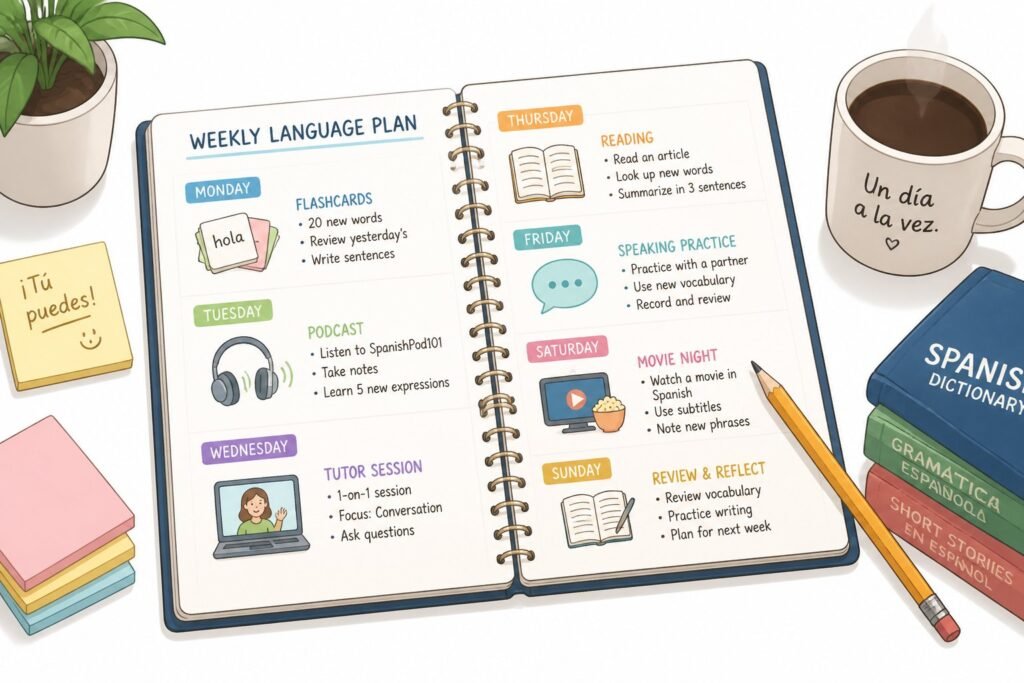
Here’s a realistic weekly schedule for someone with 30–45 minutes a day:
Monday / Wednesday / Friday — 20 min vocabulary review (flashcards + spaced repetition) + 15 min grammar or new lesson
Tuesday / Thursday — 30 min listening: podcast or TV show with subtitle support
Saturday — 45 min speaking: tutor session or language exchange
Sunday — Free immersion: a YouTube video, a show, or just reading something casual in the target language
This isn’t the only way to structure your learning. But having a plan prevents the “I’ll study later” spiral that kills most language study routines.
Language Learning Tips by Skill Level
If You’re Just Starting
Focus on the top 500–1,000 most common words, basic sentence structure, and pronunciation from day one. Mispronouncing things early creates habits that are hard to break. Many apps include audio from native speakers — use it.
If You’re Intermediate and Stuck
The intermediate plateau is real. You understand the basics but feel like you’re not making progress. This usually means you’re not getting enough input at the right level.
Push yourself toward native content — shows, books, podcasts — even if it feels hard. Struggling with real content is where real growth happens. Consider increasing your tutor sessions during this phase.
If You’re Advanced
At this stage, effective learning looks like full immersion in authentic content. Read books, watch news, have unstructured conversations about complex topics. Work on subtle things: idioms, humor, cultural references that never show up in a language course.

Common Mistakes That Slow You Down
Waiting to speak until you’re “good enough.” You won’t get good enough until you speak. This is circular logic that keeps people stuck for years.
Trying to memorize every grammar rule before using the language. Grammar is a tool, not a prerequisite. Learn enough to start, then learn the rest in context.
Switching languages every few months. Jumping from Spanish to Japanese to French because something new looks exciting resets your progress every time. Commit to one language until you reach a meaningful milestone.
Treating every language learning session like a test. Making mistakes is the mechanism by which you learn. Stop grading yourself and start playing.
The Honest Timeline
Here’s what you can expect if you’re consistent:
- 1–3 months: Basic phrases, survival vocab, simple conversations
- 3–6 months: Conversational on familiar topics, real comprehension improving
- 6–12 months: Comfortable in most everyday situations, can watch TV shows with some help
- 1–2 years: Near-fluent, able to speak on complex topics with minimal struggle
These timelines assume regular practice — not perfect practice, just regular. Missing a day doesn’t matter. Missing a month does.
Pick your language. Set your goal. Start today.
The only people who fail to learn a language are the ones who stop.