Table of Contents
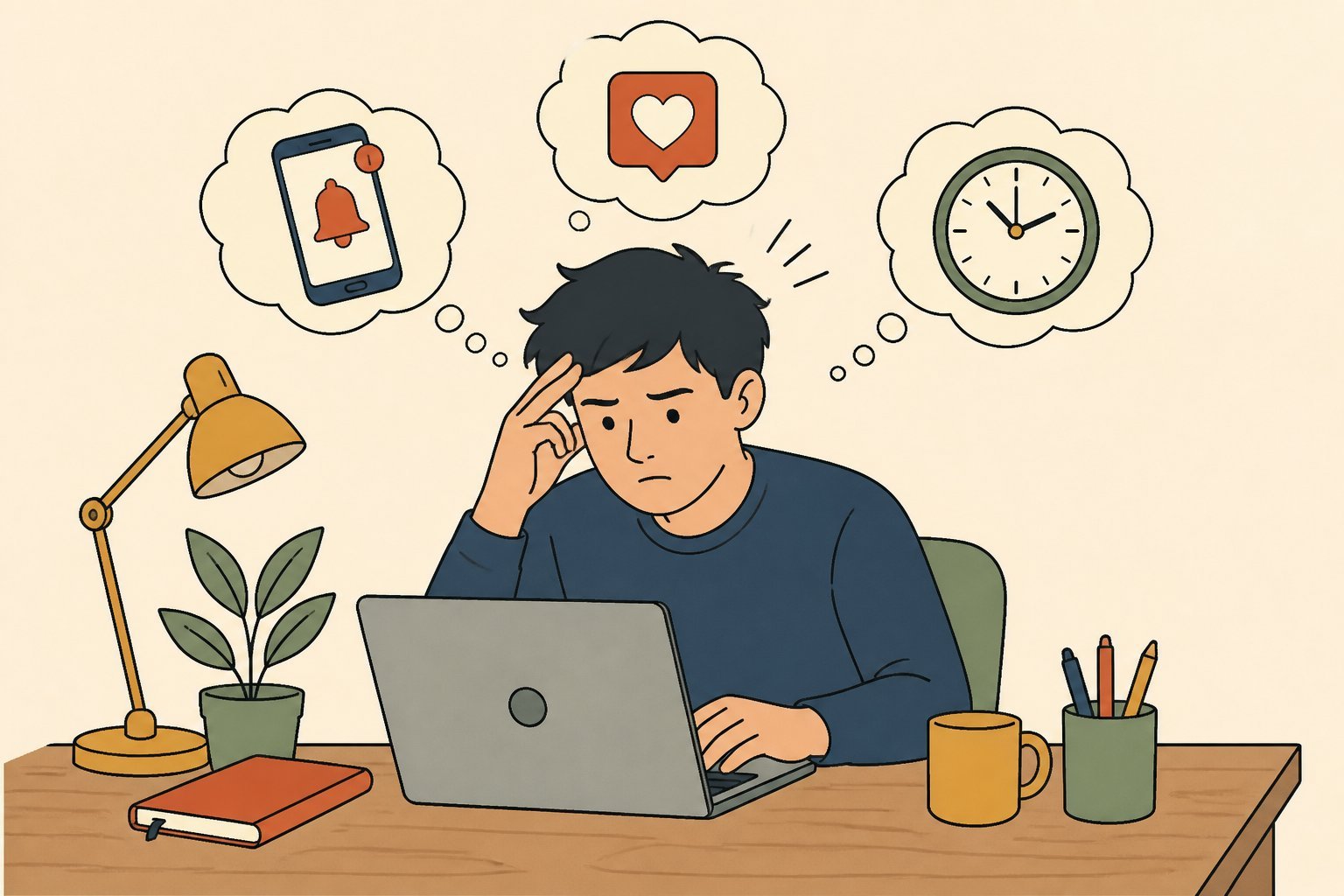
The average person checks their phone 96 times a day. Every time you pick it up, research shows it takes about 23 minutes to get back into deep focus — if you even manage to get there at all.
That’s not a willpower problem. That’s a systems problem.
If you’ve been struggling to focus lately, you’re not broken. Your brain is doing exactly what it’s designed to do in a world engineered to distract it. The good news: you can learn how to improve concentration with the right habits, a few environment changes, and an honest look at what’s actually pulling your attention away. Here’s what actually works.

Why Your Attention Span Feels So Short Right Now
Before blaming yourself, it helps to understand what’s actually happening.
Your brain isn’t built for sustained attention in a world of constant notifications. Every ping, every tab, every social media site refresh delivers a small dopamine hit that makes focusing your attention on a single task feel dull by comparison. Over time, your brain gets rewired to crave that stimulation. The result: sitting down to do real work feels harder than ever.
A few things that directly affect concentration and focus:
- Chronic sleep deprivation — even one bad night tanks your cognitive function significantly
- Switching between tasks constantly — your brain pays a “switching cost” every time you jump from one task to another
- A notification-heavy environment — one notification can break your concentration and attention for far longer than it takes to read it
- Dehydration and poor nutrition — both hit harder than most people realize
- Underlying health conditions — things like anxiety, ADHD, thyroid issues, or other medical conditions can make it genuinely difficult to focus
If you’ve always had trouble concentrating, or if it’s gotten significantly worse, it’s worth mentioning to a doctor. But for most people, the following tips to improve focus will make a measurable difference.
Remove Distractions Before You Try to Focus
This sounds obvious. Most people skip it anyway.
The single most effective thing you can do to improve your ability to focus is make distraction physically harder to access. Not “try harder to ignore your phone” — actually move it. Put it in another room. Turn off every notification on your laptop except the ones that are genuinely urgent. Close every browser tab that isn’t directly related to the task at hand.
Your willpower is finite. Stop spending it fighting your environment when you can just change your environment.
Some things worth doing before you start any focused work session:
- Put your phone face-down in a drawer or another room
- Use a browser extension like Cold Turkey or Freedom to block social media sites
- Close your email app — schedule specific times to check it instead
- Tell the people around you that you need uninterrupted time
- Make sure the room temperature is comfortable — working somewhere too hot or too cold genuinely affects your ability to concentrate
The goal is to make it easy to stay focused and annoying to get distracted. Set that up before you sit down, not after.
Work in Focused Blocks, Not Marathon Sessions
The Pomodoro Technique
If you want to train your brain to focus better, the Pomodoro method is one of the most evidence-backed tools out there. It’s simple: work for 25 focused minutes, take a 5-minute break, then repeat. After four cycles, take a longer 15–30 minute break.
What makes this work is the structure. You’re not trying to stay focused for hours — you’re committing to 25 minutes. That’s psychologically manageable, even when a task feels hard to start.
The short breaks matter too. They let your brain rest without fully disconnecting, which helps you maintain focus and increase your attention span over a full work day rather than burning out by midmorning.
Single-Tasking is a Skill Worth Learning
Most people think they’re good at multitasking. Research says otherwise. When you multitask, you’re not actually doing two things at once — you’re rapidly switching between them, and each switch costs you time and mental energy. People who multitask frequently are actually worse at focusing than those who don’t.
The fix: one task at a time, worked to completion (or to a natural stopping point) before moving on. Pick the most important thing first. Write it at the top of your to-do list the night before, and make it the first thing you do in the morning — ideally during the peak hours of the day when your mental energy is highest.

Use Mindfulness to Strengthen Your Focus Muscle
Mindfulness isn’t about becoming a monk. It’s about learning to notice when your attention has wandered — and bringing it back without a big internal drama about it.
That noticing-and-returning is exactly the mental movement that builds focus. Every time you catch yourself thinking about something else and redirect your attention back, you’re doing a rep. Daily meditation, even just 10 minutes a day, has been shown to improve attention and focus over time, including in people with attention difficulties.
You don’t need an app, though apps like Headspace or Calm make it easier to start. Sit quietly, pay attention to your breathing, and every time your mind wanders — which it will — bring it back. That’s the whole practice.
Even a few minutes a day adds up. People who do this consistently report feeling more focused, less reactive to distraction, and better at maintaining focus during long working or studying sessions.
Sleep More. Seriously.
Nothing wrecks concentration and focus faster than poor sleep. Not coffee, not sheer determination, not a productivity system — there is no substitute for adequate sleep when it comes to cognitive function.
When you’re sleep-deprived, your attention span shrinks, your reaction time slows, and your ability to filter out irrelevant information falls apart. You’re also more likely to procrastinate and more likely to get distracted by things that don’t matter.
To improve sleep in a way that actually sticks:
- Go to bed and wake up around the same time every day — even on weekends
- Avoid screens for at least an hour before bed
- Keep your room cool and dark
- Cut off caffeine after 2pm
Most adults need 7–9 hours. If you’re regularly getting less than 7, that’s the number one thing to fix before worrying about any other focus strategy.
Stay Hydrated and Watch What You Eat
Your brain is roughly 75% water. Even mild dehydration — before you feel thirsty — can affect concentration, mood, and memory and attention. Stay hydrated throughout the day: aim for at least 6–8 glasses of water, more if you’re active or in a warm climate. Hydrate proactively, not reactively.
Food matters too. Big, heavy meals make you tired. Highly processed foods with lots of sugar cause energy spikes followed by crashes — exactly the opposite of what you want when you need to focus in class or power through a complex project. Protein, healthy fats, and slow-digesting carbs support brain health and help you stay alert through long periods of time.
If you’re having trouble concentrating in the afternoon, look at what you ate for lunch before blaming your attention span.

Listen to Music — The Right Kind
Music can help you focus, but the type matters a lot.
Instrumental music — ambient, classical, lo-fi beats, or even certain video game soundtracks — tends to support deep focus without pulling your brain into lyric-processing mode. Many people find that listening to music while doing repetitive or mechanical work speeds them up noticeably.
For complex tasks that require heavy thinking or careful reading, silence or very minimal background sound often works better. Focus and increase your attention naturally when there’s less sensory competition.
Experiment with it. Some people focus significantly better with background noise. Some need silence. Neither is wrong — what matters is that you know which one you are and set up accordingly.
Avoid: music with lyrics you know well, podcasts, or anything that makes you want to sing along. Those pull your attention toward the audio and away from the work.
Build a Daily System That Protects Your Focus
One-off tactics help. A consistent daily system changes things long-term.
The basics of a focus-friendly routine:
Start with your hardest task. Don’t warm up by checking email or Slack. Spend too much time on small things early, and you’ll be trying to do your most important work late in the day when your mental energy is depleted.
Write a short daily task list the night before. Not a 20-item wish list — 3 to 5 things that are important to get done that day. Knowing what you need to get done before you sit down removes the friction of deciding where to start.
Take real breaks. Not “scroll social media for 10 minutes” breaks. Stand up, move around, step outside. Short breaks where you genuinely disconnect help you come back sharper.
Protect the mornings. For most people, the first 2–3 hours of the day are their peak cognitive hours. Guard that time. No meetings, no inbox, no chat apps. Use it for the work that requires your full brain.
If you’ve tried the above and you’re still having serious trouble concentrating — especially if it’s affecting your work, relationships, or daily life — it may be worth talking to a doctor.
ADHD, anxiety, depression, thyroid conditions, and other health conditions can all make it genuinely difficult to focus in ways that lifestyle changes alone won’t fully fix. ADHD in particular is frequently underdiagnosed in adults, and many people spend years assuming they’re just lazy or undisciplined before finding out there’s a neurological explanation.
Getting evaluated isn’t giving up. It’s learning how to improve concentration in a way that actually fits your brain.

The One Thing to Do Differently Starting Today
Learning how to focus isn’t about doing more. It’s about doing fewer things — and doing them better.
Pick one thing first. Not three productivity apps, not a total schedule overhaul. One: start putting your phone in another room when you sit down to work. Just that. Do it for a week and see what changes.
The top tips for improving focus all point in the same direction: less noise, more intention, better defaults. Build those slowly and your ability to concentrate will follow.