Table of Contents
You spend 40 hours a week at a job, but most people spend less than two hours on the resume that gets them there. Recruiters spend an average of six to seven seconds scanning a resume before deciding whether to read further. Six seconds. That’s not much room for error.
Whether you’re starting from scratch or fixing a resume that hasn’t been getting responses, this guide walks you through every section — what to include, how to format it, and how to make your resume stand out without overcomplicating it.

What Is the Purpose of a Resume?
A resume is a concise summary of your professional experience, education, and skills — designed to convince an employer you’re worth interviewing. That’s it. The purpose of a resume isn’t to tell your life story or list every task you’ve ever done. It’s to get your foot in the door.
Think of it as a marketing document, not a biography.
Every line should answer one question: why should this employer call me? If a line doesn’t answer that, cut it.
Choose the Right Resume Format Before You Write Anything
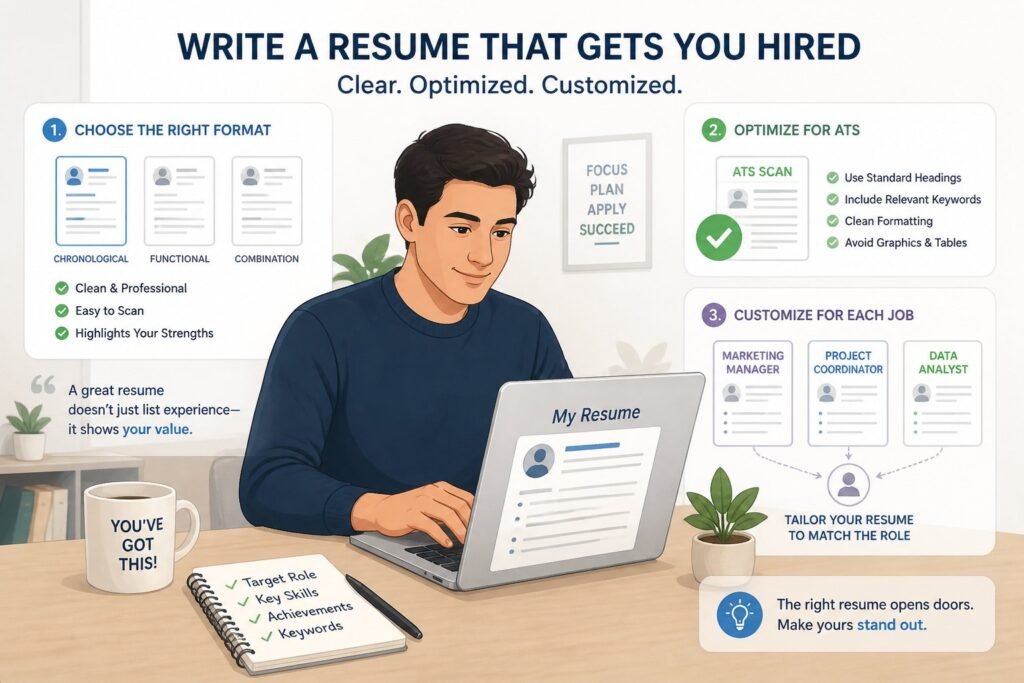
Before you write a single word, you need to pick the right structure. The format you use depends on where you are in your career.
Chronological Resume (Most Common)
The chronological resume lists your work experience in reverse chronological order, starting with your most recent job. This is what most employers expect to see, and it’s what most applicant tracking systems (ATS) are built to read.
Use this if you have a steady work history and you’re applying for a role similar to what you’ve done before.
Functional Resume
This format puts skills front and center instead of job titles and dates. It’s designed for career changers or people with employment gaps — but be warned: many recruiters don’t love it, and some ATS platforms struggle to parse it.
Combination Resume
A combination resume blends both approaches. You lead with a strong skills section, then follow up with your chronological work history. It works well for people with a mix of transferable skills and solid relevant experience.
When in doubt, go chronological. It’s readable, familiar, and ATS-friendly.
How to Format a Resume That’s Easy to Read
Formatting your resume isn’t about making it pretty. It’s about making it easy for a recruiter — and an ATS — to find what they’re looking for in seconds.
Margins, Font, and Spacing
- Margins: 0.5 to 1 inch on all sides
- Font: Stick with a clean, professional font — think Arial, Calibri, or Georgia — at 10–12pt for body text
- Headings can go up to 14pt to help sections stand out
- Keep consistent spacing between sections
One font. Two sizes maximum. No graphics, no fancy columns if you’re submitting through an ATS.
Resume Length: One Page or Two?
For most job seekers with under 10 years of experience, one page is the goal. Two pages is fine if you genuinely have the experience to fill it — but don’t pad it just to look substantial.
If you’re sending a two-page resume, make sure your strongest content is on page one. Recruiters may never reach page two.
File Format
Unless the job posting specifies otherwise, submit your resume as a PDF. It preserves your formatting across every device. Word documents can shift and look completely different when opened on another computer.
Write a Resume Header and Professional Summary That Hook the Reader
Your Header
Your resume header is the first thing an employer sees. Keep it clean:
- Full name (slightly larger font)
- Phone number
- Professional email address
- LinkedIn profile URL
- City and state (you don’t need your full street address)
That’s all. A heading with a professional photo, quote, or decorative banner belongs on a design portfolio, not a job application.
Professional Summary
Right below your header, add a 2–3 sentence professional summary. This is your elevator pitch — a tight snapshot of who you are, what you do well, and what you’re looking for.
Avoid generic lines like “results-driven professional seeking to leverage skills.” Instead, try something like:
“Marketing manager with 6 years of experience running paid campaigns for SaaS companies. Consistently reduced cost-per-acquisition by 20%+ by combining data analysis with creative testing.”
Specific. Quantified. Relevant.
How to Write Your Work Experience Section
This is the most important section of your resume. Most hiring decisions come down to this.

Structure Each Job Entry Clearly
For each position, include:
- Job title (bold it)
- Company name and location
- Month and year you started and ended (e.g., March 2021 – November 2023)
- 3–5 bullet points describing your responsibilities and achievements
List recent experience first. Reverse chronological order is standard, and skipping it will confuse both human readers and ATS software.
Achievements Over Duties
Most resumes read like job descriptions. Don’t write a job description — write proof that you were good at the job.
Bad: “Responsible for managing social media accounts.” Better: “Grew Instagram following from 4,000 to 22,000 in 12 months by launching a weekly video series.”
The difference is numbers and outcomes. Wherever you can, add a metric.
Use Strong Action Verbs to Start Each Bullet
Strong action verbs make your bullet points punch. Start each one with a different verb:
- Led, directed, managed
- Built, created, designed
- Improved, reduced, increased
- Analyzed, researched, audited
- Trained, mentored, coached
Avoid starting with “Responsible for” or “Helped with.” These are passive and weak.
Write a Skills Section That Actually Means Something
A skills and qualifications section can help — or it can be a wasted block of resume space. It depends entirely on what you put in it.
Hard skills (technical and measurable) are worth listing:
- Software: Salesforce, Figma, Python, Excel
- Certifications: PMP, Google Analytics, AWS
- Languages: Spanish (fluent), French (conversational)
Soft skills like “great communicator” or “team player” are borderline useless on their own. Every candidate claims them. Show those skills in your experience section instead.
How to Beat the Applicant Tracking System (ATS)
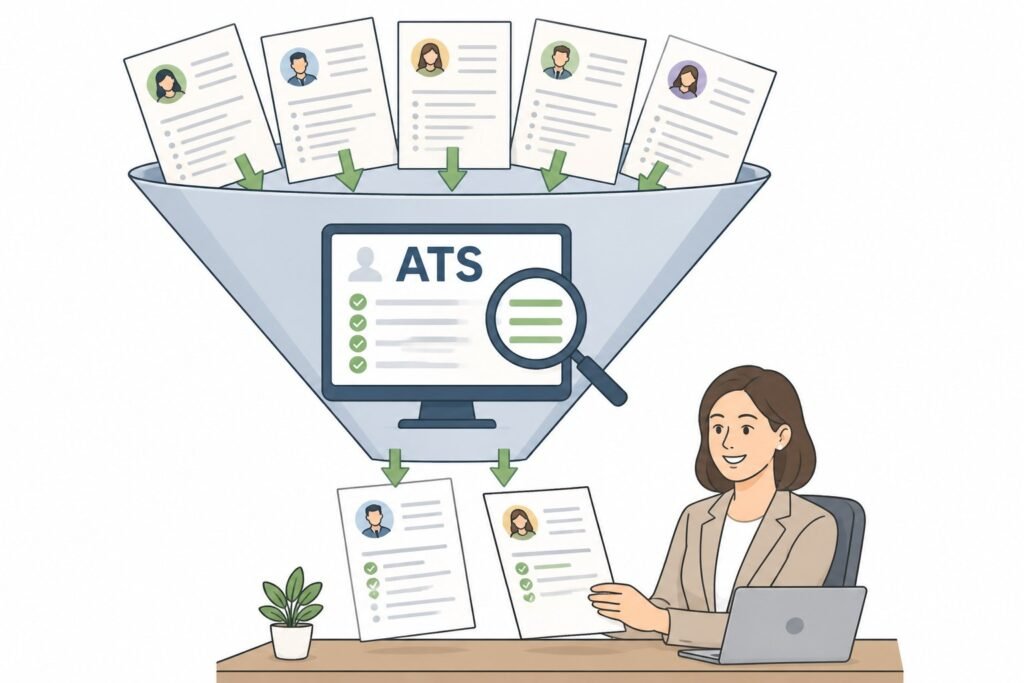
Before a human reads your resume, it’s almost certainly going through an applicant tracking system. An ATS scans your resume for keywords from the job posting and ranks you against other candidates. If your resume doesn’t match, it may never reach a recruiter’s inbox.
How to Tailor Your Resume for Each Job
Tailor your resume for every role you apply to. It sounds like a lot of work — but it’s the single most effective resume writing tip there is.
Here’s how to do it efficiently:
- Read the job description carefully and note the specific skills, tools, and qualifications mentioned
- Compare your resume to the posting — look for gaps
- Add relevant keywords from the job description into your resume naturally (don’t just stuff them in)
- Customize your professional summary to reflect the specific job title and company
You’re not lying or exaggerating. You’re adjusting which parts of your experience you emphasize.
Keywords in Your Resume: What to Watch For
Keywords in the job description are your guide. If the job posting mentions “project management” six times, make sure those words appear in your resume. If it says “Agile methodology,” use that exact phrase — not just “Agile.”
The ATS looks for exact matches. Even a slight variation can cost you.
Use your applicant tracking system knowledge to your advantage: mirror the language in the job description wherever it’s true to your experience.
Education, Certifications, and Additional Sections
Education
List your degrees in reverse order, starting with the most recent. Include:
- Degree and major
- School name and location
- Graduation year
If you graduated more than a few years ago, GPA is optional (and often better left off unless it was exceptional).
Certifications and Professional Development
If you hold certifications relevant to the job you’re applying for, list them. These can sit in their own section or under education. Include the certifying body and the year, especially for certifications that expire.
What About Hobbies and Interests?
Skip them unless they’re directly relevant to the job. A software developer applying to a gaming company? Mentioning that you build indie games on the side makes sense. Listing “hiking and cooking” on a finance resume wastes space.
Build Your Resume Checklist Before You Hit Send
Before submitting your resume, run through this quick checklist:
- Contact information is current and professional
- Resume is tailored to the specific job description
- No typos, grammar errors, or inconsistent formatting
- All dates are accurate and in a consistent format (month and year)
- Bullet points start with strong action verbs
- At least 2–3 bullet points per job include a number or measurable result
- File is saved as a PDF unless otherwise requested
- Font is consistent and readable at 10–12pt
- No photos, graphics, or unusual design elements that could confuse ATS
If you can check every box, you’ve written a strong resume.
Resume and Cover Letter: Don’t Skip the Second One
A well-crafted resume and cover letter together give you a stronger shot than either alone. Your cover letter isn’t a repeat of your resume — it’s the place to explain why you want this specific role and what makes you different.
Keep it to three or four short paragraphs. Address it to the hiring manager by name if you can find it. And actually write it — don’t use a template with the company name swapped in. Recruiters can tell.
A Few Last Resume Writing Tips Worth Keeping
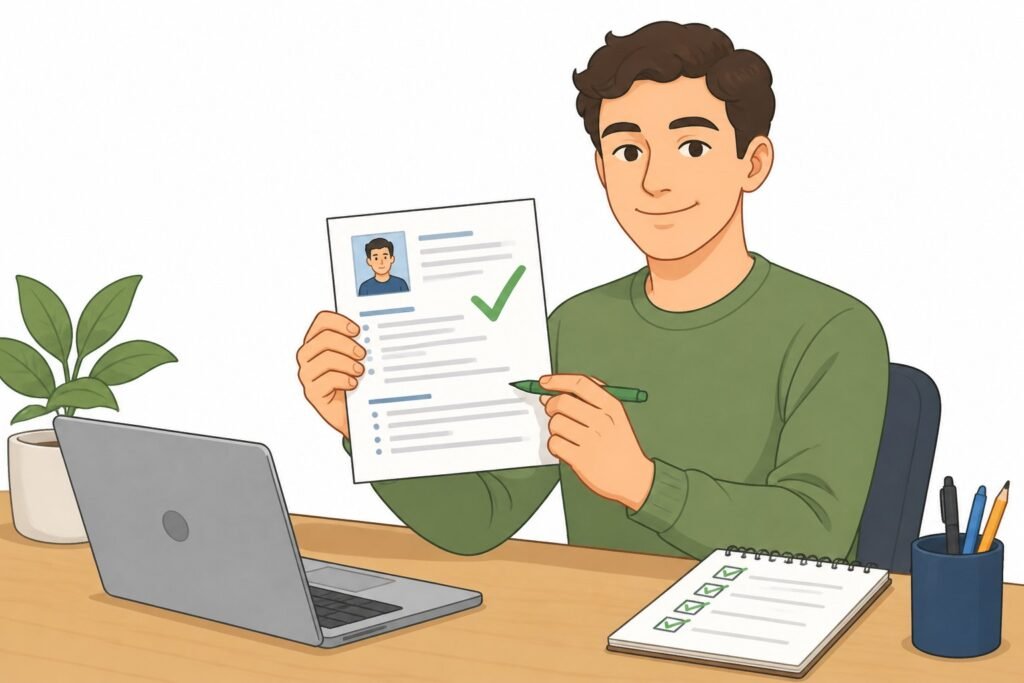
Get a second pair of eyes on it. You’ve read your own resume so many times you’ll miss obvious errors. Ask someone you trust — or use your university’s career center or career services office if you have access.
Keep multiple versions. If you’re applying in a few different directions, maintain versions of your resume tailored to each. A project manager resume and a product manager resume might look quite similar on the surface, but the keywords and emphasis will differ.
Update it before you need it. The best time to update your resume is when you’re not desperate for a job. Add new skills, projects, and achievements as they happen — not in a panic at midnight the day before a deadline.
Your resume is your first impression. A recruiter who sees a clean, tailored, achievement-focused document is going to assume you bring that same level of care to your work. That matters.
Now go write yours.