Table of Contents
Most adults who can’t swim aren’t afraid of the water — they’re afraid of looking foolish in it. The truth? Every strong swimmer you’ve ever seen was once standing at the edge of the pool, heart pounding, wondering the same thing you are right now. Learning how to swim is completely doable at any age, and you don’t need raw athleticism to get there. You need the right sequence, a little patience, and the willingness to put your face in the water.
This guide to swimming covers everything a complete beginner needs — from floating to freestyle — in the order that actually makes sense.
Why So Many Adults Never Learn to Swim — and Why It’s Never Too Late to Learn
About 54% of Americans can’t perform the basic swim skills needed to save their own life in the water, according to the American Red Cross. That number is jarring, but the reason behind it is simple: most people who didn’t learn as kids never had a structured opportunity later on.
The good news? Adults actually have some advantages over children as learners. You can understand instructions abstractly, you can consciously control your body mechanics, and you can practice deliberately. Beginner swimming lessons designed for adults are widely available, and plenty of people learn to swim confidently well into their 40s, 50s, and beyond.
The first step isn’t jumping in. It’s getting comfortable in the water.
Getting Comfortable in the Water Before You Try to Swim
Fear in water is physical, not just mental. Your body tenses up, your breathing gets shallow, and you fight the water instead of working with it. You have to disrupt that cycle before anything else will stick.
Start in the Shallow End
Go to the shallow end of the pool where you can stand. Walk around. Splash water on your arms and face. Submerge your shoulders. Blow bubbles by dipping your mouth just below the surface. None of this is embarrassing — it’s exactly what your nervous system needs before you ask it to do anything harder.
Practice Exhaling Underwater
This is the single most important beginner skill almost no one teaches first. Hold onto the side of the pool, take a breath through your nose and mouth, and slowly exhale through your nose while your face is in the water. Do it ten times. When exhaling underwater feels normal, the rest of the breathing mechanics in swimming will come much faster.
Bob Up and Down
Stand in chest-deep water. Take a breath, submerge your whole head, exhale through your nose, then push off the bottom of the pool back to the surface. Repeat. This builds trust with the water — you start to feel that it will push you back up.
How to Learn to Float (The Foundation of Everything)
You can’t swim well if you can’t float. Floating isn’t a passive skill — it’s about finding your body’s natural buoyancy and stopping yourself from fighting it.
The Back Float
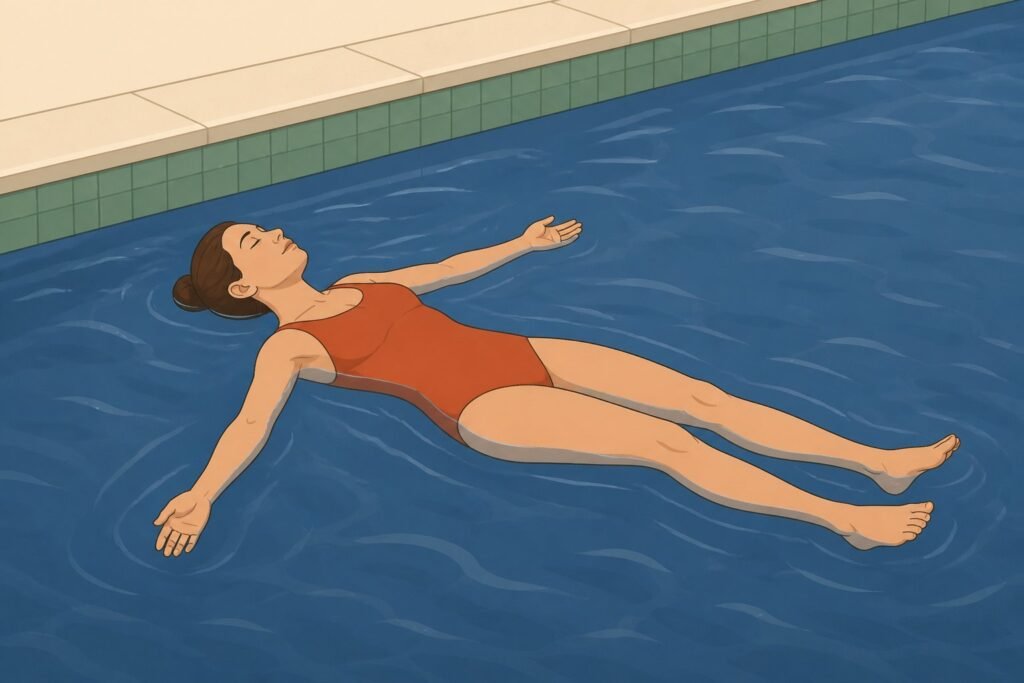
Lean back in shallow water with your ears submerged, arms out to your sides, and hips pushed up toward the surface. Keep your head back — the moment you lift your head to look around, your hips sink. A swimming instructor will often support your lower back while you find this position. Once you feel the water holding you up, you’ll understand what “relaxing into the water” means.
The Front Float
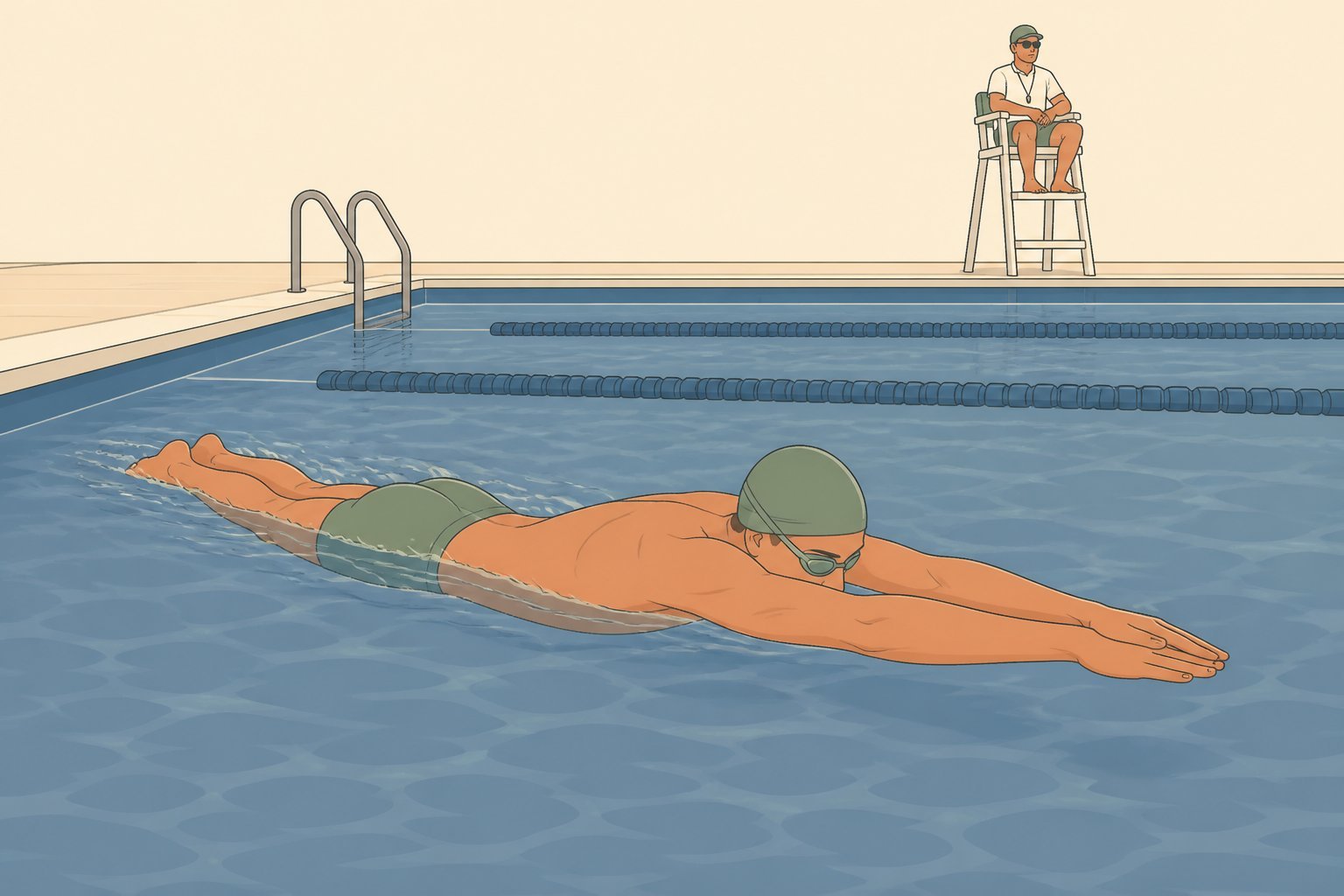
From a standing position, take a breath, put your face in the water, and let your body rise horizontal. Keep your arms extended in front of you. Most beginners tense up and sink — the fix is almost always to breathe out slowly and stay relaxed. If you’re sinking, you’re either holding your breath or tensing your legs.
Using a Kickboard or Pull Buoy
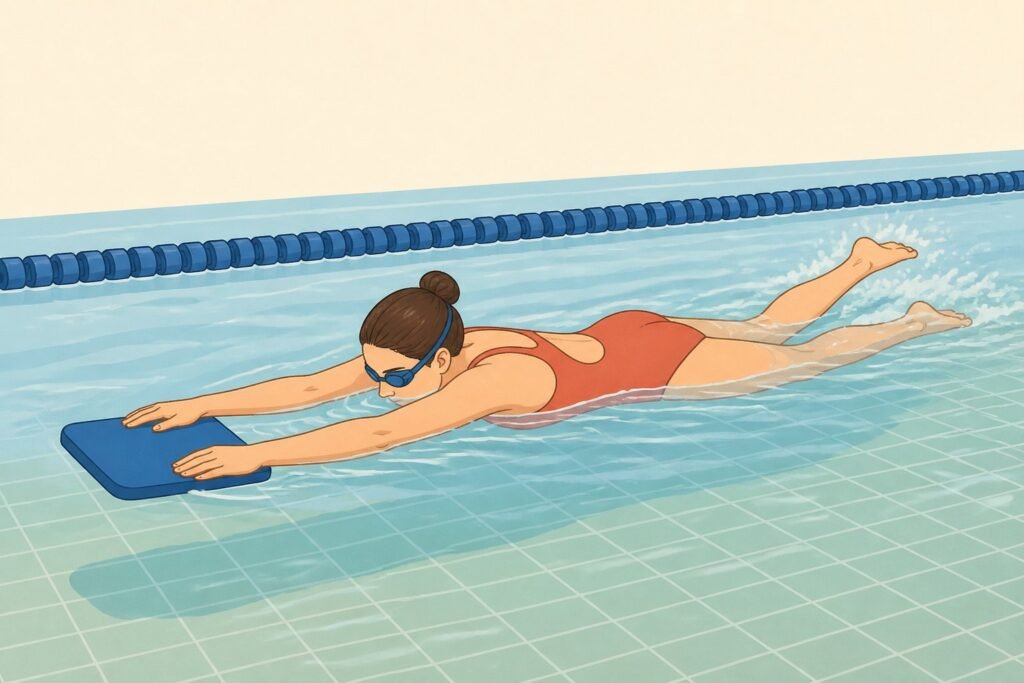
A kickboard keeps your upper body afloat while you practice your kick. A pull buoy goes between your thighs to keep your lower body up while you focus on arm movements. Both are standard gear at any pool and make it much easier to isolate one part of your technique at a time.
Basic Swimming Strokes Every Beginner Should Know
There are four major strokes in competitive swimming. As a beginner, you only need to focus on two: freestyle (also called front crawl) and backstroke. Master those before touching the others.
Freestyle / Front Crawl
Freestyle is the fastest and most efficient stroke, and it’s the first one most swim lessons teach. Here’s how it breaks down:
Body position: Keep your body as flat and horizontal as possible on the surface of the water. Your head should be face-down with the waterline at your hairline — not tilted up.
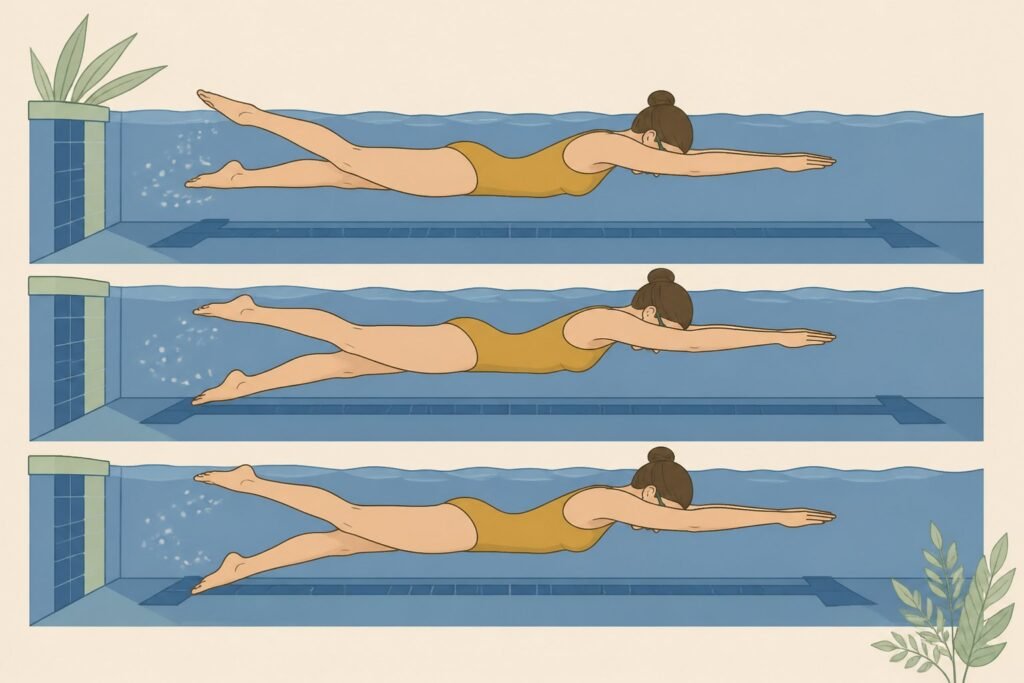
The kick: Use a flutter kick — quick, alternating up-and-down leg movements starting from the hip, not the knee. Point your toes, keep your ankles loose, and keep your legs close together. Big, splashy kicks waste energy and slow you down.
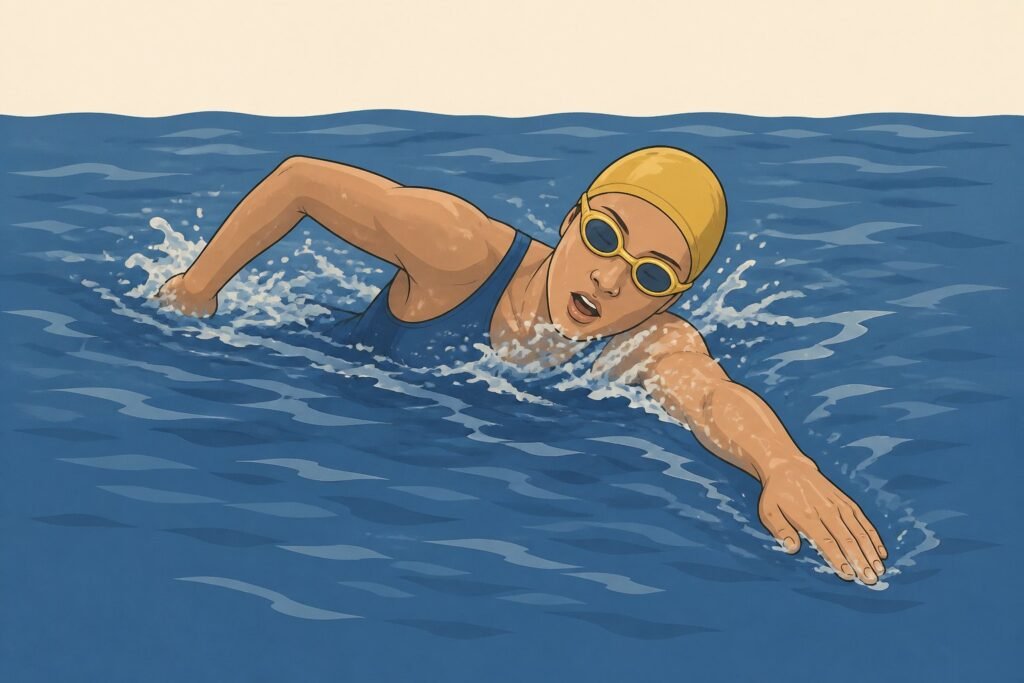
The arm stroke: Reach one arm forward, pull it down through the water toward your hip (this is your propulsion), then lift your arm out of the water and recover it forward again. One arm pulls while the other extends. It’s a continuous alternating motion.
Breathing: Turn your head to breathe — don’t lift it. As one arm pulls past your hip, rotate your head to that same side just enough so your mouth clears the surface. Take a breath, then rotate back down and exhale through your nose and mouth as your face returns to the water. Most beginners hold their breath too long; try to exhale continuously the moment your face goes back in.
Backstroke
Backstroke uses a similar flutter kick and alternating arm motion as freestyle, but you’re on your back. Keep your hips up and your head still — your eyes should point straight up at the ceiling. The biggest beginner mistake here is letting the hips sink. Keep your core engaged and your body flat. Backstroke is great for practicing breathing without the timing challenge of front crawl.
Breaststroke
Breaststroke comes next after you’re confident in freestyle. The arm motion is a simultaneous pull — both arms sweep outward and then pull inward under the chest. The kick, called a whip kick, involves drawing your heels up toward your seat and then pushing your feet outward and together in a circular motion. Timing is everything in breaststroke: pull, kick, and glide each happen in sequence, not simultaneously.
What About Butterfly?
Butterfly is the hardest stroke and not something a beginner needs to worry about. It requires a solid dolphin kick, precise timing, and real upper body strength. Get comfortable in the water first.
Essential Gear That Actually Makes a Difference
You don’t need much to start swimming. But a few things genuinely improve your experience as a beginner.
Goggles: Non-negotiable. Chlorine stings and blurs your vision. A well-fitted pair of goggles lets you see underwater, which makes breathing timing dramatically easier. You should be able to press them against your eyes and have them create light suction without the strap — that’s the right fit.
Swim cap: Not just for long hair. A swim cap reduces drag and keeps hair out of your face during drills. Latex is cheaper; silicone is more comfortable for regular use.
Kickboard: Available at most pools to borrow. Use it to practice your kick without worrying about your arms.
Fins: Short training fins help beginners feel what a strong kick should feel like. They’re not a crutch — many experienced swimmers use fins for conditioning drills.
A pull buoy is also worth trying early on. It removes the kick entirely so you can focus on your arm stroke and breathing without managing everything at once.
Common Beginner Mistakes and How to Fix Them
Lifting the head to breathe: One of the most common errors in freestyle. When you lift your head, your hips drop and your stroke falls apart. Practice turning your head — not lifting it — by keeping one goggle in the water during the breath.
Not exhaling underwater: If you’re gasping every time your face comes out of the water, you’re not exhaling while it’s in. Exhale steadily through your nose the whole time your face is submerged.
Kicking from the knees: Bend at the knee and your kick creates drag instead of propulsion. The flutter kick comes from the hip, with a slight bend at the knee. Think of your whole leg as a flipper.
Poor body position: Swimmers who keep their head too high, or their hips too low, work twice as hard to move through the water. Keeping your body as flat as possible — the “streamline” position — is the single biggest factor in swimming efficiency.
Reaching too far across the body: In freestyle, each arm should enter the water at roughly the same width as your shoulder, not crossing the centerline of your body. Crossing causes your body to snake through the water and kills your momentum.
How to Structure Your First Few Weeks of Swim Lessons
If you’re teaching yourself, structure matters. Here’s a rough framework for your first month of beginner swimming:
Week 1 — Water comfort and floating
- 15–20 minutes in the shallow end: submersion, bubble-blowing, bobbing
- Practice back float and front float with a wall or instructor support
- No swimming yet — just getting comfortable in the water
Week 2 — Kick mechanics
- Hold the edge of the pool and flutter kick for 10 x 25-meter sets
- Use a kickboard and kick the length of the pool
- Add goggles this week if you haven’t already
Week 3 — Freestyle arms with breathing
- Practice the arm stroke standing in shallow water
- Add one-arm freestyle drills: extend your arms, pull with one arm while the other stays forward, turn your head to breathe
- Try short lengths of freestyle with a pull buoy so you don’t have to manage the kick yet
Week 4 — Full stroke integration
- Swim freestyle for 25 meters, rest, repeat
- Focus on breathing rhythm — exhale fully before turning your head
- Try a length of backstroke to break it up
If you’re taking swim lessons with a swimming instructor, they’ll adapt this to your specific swimming level. But the sequence — comfort, float, kick, arms, full stroke — holds regardless.
How to Keep Getting Better After the Basics
Once you can swim a length of the pool without stopping, the work shifts to technique and training. Poor technique that feels fine at slow speeds becomes a real problem when you try to swim longer or faster.
A few things that accelerate improvement:
Count your strokes. Fewer strokes per length usually means better technique. If you’re taking 30 strokes per 25 meters, work to get it under 20 by extending your reach and finishing each pull completely.
Record yourself. You’ll be surprised by the gap between what swimming feels like and what it looks like from above or below. One underwater video is worth hours of drilled advice.
Join a masters swim group. Masters swimming clubs are for adults of every swimming level and are far less intimidating than they sound. Having a set workout and lane mates is the fastest way to improve after the basics.
Focus on your technique before your distance. Adding distance too fast with a flawed stroke just entrenches the flaws. Swim shorter distances with proper technique and the fitness will follow.
You Already Know the Hard Part
The hardest thing about learning how to swim isn’t the mechanics — it’s trusting the water enough to try. Once you stop fighting it, the rest follows surprisingly quickly.
Start where you are. Spend a few sessions just getting comfortable in the water. Learn to float. Add the flutter kick. Add your arms. Before long, you’ll be doing something that felt impossible a few weeks ago — and wondering what took you so long to start.
The pool will be there tomorrow. Go this week.